
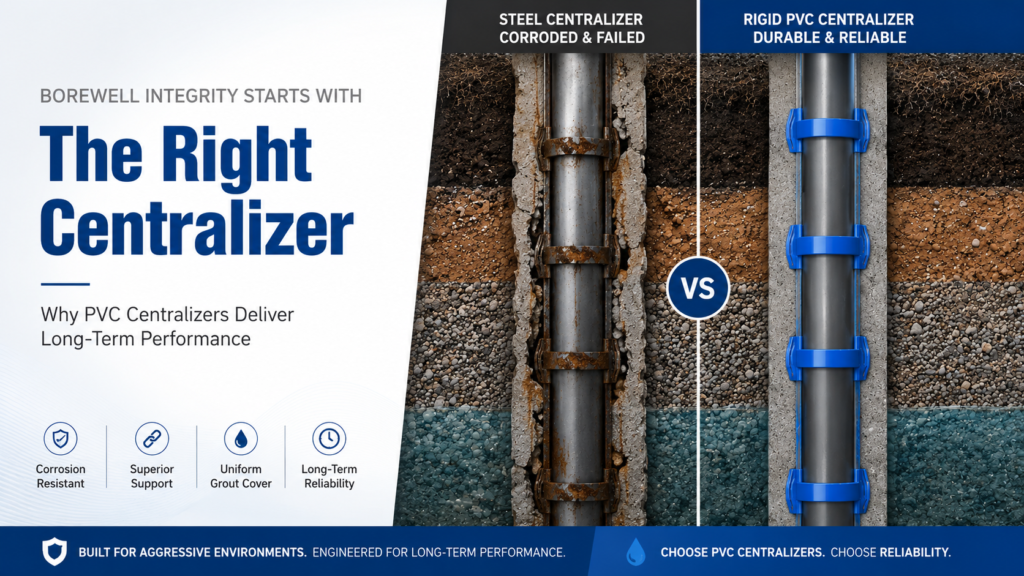
Specifying the wrong centralizer material in a corrosive ground environment does not show up as a problem during construction. It shows up five to fifteen years later, when pile rehabilitation costs arrive and the original material specification is the first thing reviewed.
A PVC centralizer in a corrosive environment does what its steel equivalent cannot: it retains its geometry, its load-bearing function, and its grip on the reinforcement bar across the entire design life of the pile, regardless of what the surrounding ground chemistry does to it. The reason is not product quality. It is material chemistry.
This article explains the chemistry behind PVC’s corrosion resistance, how steel centralizers fail in the same conditions, and how Indian engineers can use this knowledge to specify the right centralizer for corrosive ground applications across coastal zones, industrial sites, and aggressive soil formations.
What Makes a Foundation Environment “Corrosive”?
A corrosive foundation environment is any ground condition that contains chemical agents capable of degrading metals or other susceptible materials embedded within it. In foundation construction, corrosion matters because it degrades not just the reinforcement bar but also any metallic accessory in contact with it, including steel centralizers, before the grout cover that should protect them has fully established its protective function.
Four primary chemical agents define corrosive ground in Indian construction contexts.
Chloride-Rich Soils and Groundwater
Chloride ions accelerate electrochemical corrosion of steel through a process called pitting corrosion. Chlorides penetrate the passive oxide layer that normally protects steel surfaces, creating localised corrosion cells that eat through steel faster than general surface oxidation. Coastal soils within 5km of the sea, tidal zones, saline groundwater zones, and ground influenced by road salt or industrial brine all carry high chloride concentrations.
India’s entire eastern and western coastlines, including construction belts around Mumbai, Chennai, Vizag, Kochi, and Kolkata, fall into this category. Coastal micropile and foundation projects in these zones face chloride exposure from the moment installation begins.
Sulfate-Bearing Ground
Sulfates in soil and groundwater attack cementitious materials and corrode steel through sulfate reduction reactions. Industrial sites, clay-rich soils, waterlogged ground, and areas adjacent to landfills commonly carry elevated sulfate concentrations. Gujarat’s industrial corridor, Odisha’s mining belt, and waterlogged delta soils in West Bengal and Andhra Pradesh represent high-sulfate ground conditions that Indian engineers encounter regularly.’
Acidic and Organic Soils
Low-pH groundwater and organic soils, including peat, decomposed vegetable matter, and ground contaminated by industrial waste, create acidic conditions that accelerate metal corrosion and can attack some synthetic materials. Forested areas, former agricultural land, and sites near industrial discharge points in India often show pH readings below 5.5.
Combined Aggressive Conditions
Many Indian project sites combine multiple aggressive agents simultaneously. A coastal industrial site in Gujarat or a port expansion in Chennai may present chloride exposure, sulfate contamination, and low-pH groundwater at the same time. In these combined aggressive environments, material performance under any single agent understates the actual degradation risk across the pile service life.
The Chemistry of PVC: Why It Does Not Corrode
PVC centralizers resist corrosion because polyvinyl chloride is not a metal. Corrosion, in the electrochemical sense that destroys steel, requires a metallic material capable of losing electrons to an electrolyte. PVC has no free electrons to lose. It cannot participate in electrochemical corrosion reactions.
What PVC Is Made Of
Polyvinyl chloride is a synthetic polymer built from repeating vinyl chloride monomer units. The carbon-chlorine and carbon-hydrogen bonds that form its polymer backbone are highly stable under the chemical conditions present in foundation environments. The polymer chain does not interact with water, chloride ions, sulfate ions, or moderate concentrations of acid or alkali in the way that metals do. PVC is chemically inert to the primary aggressive agents that corrode steel in the ground.
How PVC Resists Chlorides
Steel corrodes in chloride environments because chloride ions break down the passive oxide film on the steel surface, exposing fresh metal to the electrolyte and initiating a corrosion current. PVC has no oxide film to break down and no metallic surface to expose. Chloride ions in the surrounding soil or groundwater pass through or around a PVC centralizer without chemically interacting with it. The device retains its dimensions and structural function regardless of chloride concentration or exposure duration.
How PVC Resists Sulfates and Acids
Sulfate attack on steel proceeds through a combination of direct chemical reaction and the electrochemical acceleration that sulfate-reducing bacteria mediate in anaerobic ground conditions. PVC does not participate in either mechanism. Its polymer backbone is not reactive with sulfate ions, and it does not support the electrochemical cell that sulfate-reducing bacteria require to drive metal corrosion.
In acidic ground, PVC maintains its physical and chemical integrity at pH values as low as 2 to 3, well below the conditions encountered in even severely contaminated Indian construction sites.
What PVC Cannot Resist
Honest specification requires acknowledging PVC’s limitations. PVC degrades under prolonged ultraviolet radiation exposure and above approximately 60 degrees Celsius. Neither condition applies underground. PVC also softens in contact with certain hydrocarbon solvents and concentrated organic acids above specific thresholds. These conditions are not present in standard foundation construction environments. For typical micropile, soil nailing, casing, and diaphragm wall applications across India, rigid PVC centralizers operate entirely within the material’s stable performance range.
How Steel Centralizers Fail in Corrosive Environments
The Electrochemical Corrosion Mechanism
Steel corrodes in a corrosive ground environment through an electrochemical process requiring four elements: an anode (the corroding metal), a cathode (a less reactive surface), an electrolyte (conductive groundwater or soil moisture), and a metallic path connecting them. In buried steel centralizers, the reinforcement bar and the centralizer form a galvanic cell when their surface potentials differ, and the surrounding groundwater acts as the electrolyte.
Chloride ions accelerate this process dramatically. A steel centralizer in chloride-rich coastal soil can lose measurable cross-section within three to five years of installation. By year ten, a standard mild steel centralizer without protective coating may have degraded sufficiently to release its grip on the reinforcement bar, shifting position and compromising the grout cover it was placed to maintain.
Coating Failure and Crevice Corrosion
Coated steel centralizers appear to address the corrosion problem, but coating systems introduce their own failure modes. Holiday defects in the coating created during installation become initiation points for crevice corrosion. At these defect points, the geometry of the coating gap concentrates corrosive agents and accelerates localised metal loss faster than uncoated steel corrodes in open conditions.
The interface between the centralizer clip and the reinforcement bar is particularly vulnerable, as installation stress creates micro-gaps that trap chloride-rich water and concentrate corrosive activity at the most structurally critical contact point.
The Consequence for Grout Cover
When a steel centralizer degrades in service, its failure does not trigger an inspection. The pile continues to carry load while its grout cover slowly deteriorates at the points where the centralizer once held the bar in position. By the time corrosion-related pile performance issues appear at the surface, structural rehabilitation is the only option remaining.
PVC vs Steel Centralizer in Corrosive Ground: Direct Comparison
| Factor | Rigid PVC Centralizer | Mild Steel Centralizer | Stainless Steel Centralizer |
| Chloride resistance | Full – no electrochemical reaction | Low – pitting corrosion risk | High – but costly |
| Sulfate resistance | Full – chemically inert | Low – sulfate reduction attack | High – but costly |
| Acid resistance (pH 2-7) | Full | Low | Moderate |
| Service life in aggressive ground | Equal to pile design life | 5–15 years before degradation | Equal to pile design life |
| Unit cost | Low | Low | High |
| Coating required | No | Yes (limited effectiveness) | No |
| Weight | Light | Heavy | Heavy |
| Risk of grout cover loss | Negligible | High | Low |
For coastal and industrial micropile projects in India, rigid PVC centralizers from CPS Envirotech India deliver the corrosion performance of stainless steel at standard centralizer cost.
Where in India Are Corrosive Ground Conditions Most Common?
Engineers working across India encounter corrosive ground conditions in predictable zones. Understanding these zones helps justify PVC centralizer specification before ground investigation results arrive.
Coastal zones along the entire Indian coastline, extending up to 5km inland, carry chloride-contaminated soils and groundwater. Projects in Mumbai, Navi Mumbai, Chennai, Vizag, Kochi, Mangaluru, Kolkata, and all port and harbour development zones fall in this category.
Industrial corridors including the Gujarat Chemical and Petrochemical Corridor, the Dahej Special Economic Zone, fertiliser plant zones in Rajasthan and Gujarat, and mining sites in Odisha and Jharkhand present sulfate-rich and sometimes acidic ground conditions generated by decades of industrial activity.
Saline groundwater belts in coastal Andhra Pradesh, parts of Rajasthan, and the Rann of Kutch region carry chloride concentrations in groundwater that match or exceed coastal soil concentrations, regardless of distance from the sea.
Waterlogged and organic soils in Bengal’s delta formations, Kerala’s backwater-adjacent sites, and reclaimed land across Indian coastal cities combine high moisture, organic acids, and often chloride or sulfate contamination.
For slope stabilisation and retaining wall projects in corrosive ground, CPS Envirotech India’s soil nailing centralizers provide the same full-service-life PVC chemical resistance in a geometry designed for nail bar applications.
How to Specify a PVC Centralizer for Corrosive Environments
Correct specification in corrosive ground follows the same process as standard centralizer specification, with two additional documentation steps to justify and protect the material choice.
At Design Stage
- Classify ground aggressivity from the ground investigation report: record chloride concentration, sulfate content, and pH values by soil layer.
- Specify PVC centralizer material explicitly, not “centralizer” generically, so procurement cannot substitute steel without a formal variation.
- Reference IS 2911 minimum grout cover requirements and note that PVC material selection supports long-term cover integrity in the classified aggressive conditions.
- Select the correct centralizer type for the application: rigid PVC for micropiles and ground anchors, casing centralizer for cased boreholes, soil nailing centralizer for nail bars, D-wall centralizer for panel reinforcement cages.
At Procurement Stage
- Require material confirmation from the supplier confirming PVC grade, exact OD matched to borehole diameter, and load capacity documentation.
- State explicitly in the purchase order that steel substitution is not permitted regardless of availability.
- For diaphragm wall projects in aggressive ground, CPS Envirotech India’s D-wall centralizers are manufactured specifically for deep panel cage assemblies with full PVC chemical resistance.
At Documentation Stage
- Record the ground aggressivity classification and the PVC material selection rationale in the design basis or method statement.
- This creates a defensible record if the centralizer specification faces challenge during value engineering or client review.
Standards and Further Reference
For minimum grout cover requirements and pile foundation specification standards applicable in India, refer to IS 2911: Code of Practice for Design and Construction of Pile Foundations, published by the Bureau of Indian Standards at www.bis.gov.in.
For international guidance on material selection in aggressive ground for micropile applications, the FHWA Micropile Design and Construction Guidelines (NHI-05-039) covers corrosive environment considerations in detail.
Conclusion
The chemistry explains the specification. PVC centralizers outperform steel in corrosive environments not because of manufacturing quality or product design, but because polyvinyl chloride is chemically inert to the electrochemical and chemical degradation mechanisms that destroy steel in chloride, sulfate, and acidic ground.
For Indian foundation projects in coastal zones, industrial corridors, saline groundwater belts, and organic or contaminated soils, a PVC centralizer in a corrosive environment provides full-service-life resistance at standard centralizer cost. Steel centralizers in the same conditions require costly upgrades to match that performance, or they degrade before the pile reaches mid-life.
CPS Envirotech India manufactures the complete range of PVC centralizers for Indian foundation applications. For project-specific guidance on corrosive ground applications, visit pvccentralizer.com.
Frequently Asked Questions
Why does PVC not corrode in chloride-rich soils?
PVC does not corrode in chloride-rich soils because it is not a metal and cannot participate in electrochemical corrosion reactions. Chloride ions accelerate steel corrosion by breaking down the passive oxide layer on metal surfaces, but PVC has no oxide layer and no metallic surface to attack. Chloride ions in the surrounding soil or groundwater pass through or around a PVC centralizer without any chemical interaction with the material.
Can PVC centralizers be used in marine or coastal micropile projects?
Yes. PVC centralizers are the recommended choice for marine and coastal micropile projects precisely because of their chloride resistance. In coastal and marine environments where steel centralizers face accelerated pitting corrosion from chloride exposure, rigid PVC centralizers maintain their geometry, load-bearing function, and grout cover performance across the full pile design life without any protective coating.
What is the difference between PVC and steel centralizers in terms of corrosion resistance?
PVC centralizers are chemically inert to the agents that corrode steel in foundation environments: chlorides, sulfates, and acidic groundwater. Steel centralizers corrode electrochemically in these conditions, losing cross-section and eventually their structural function. Mild steel centralizers in aggressive ground can degrade significantly within 5 to 15 years. PVC centralizers in the same conditions show no material degradation over the full pile service life.
Do PVC centralizers weaken over time in chemically aggressive ground?
No. Rigid PVC centralizers do not weaken in chemically aggressive ground under standard foundation construction conditions. PVC maintains its physical and mechanical properties in contact with chlorides, sulfates, and groundwater at pH values as low as 2 to 3. The material degrades only under prolonged UV exposure and temperatures above 60 degrees Celsius, neither of which applies to underground foundation applications.
What ground conditions in India require corrosion-resistant centralizers?
Corrosion-resistant PVC centralizers are essential in coastal soils within 5km of the sea, saline groundwater zones, industrial sites with sulfate or acid contamination, waterlogged and organic soils, and areas with pH below 6. Across India, this includes coastal project zones around Mumbai, Chennai, Vizag, Kochi, and Kolkata, the Gujarat industrial corridor, Odisha mining sites, and delta soil formations in Bengal and Kerala.
Does PVC chemical resistance affect its load-bearing function as a centralizer?
No. The chemical inertness of PVC does not reduce its mechanical performance. Rigid PVC centralizers maintain their compressive strength, shape retention, and grip on the reinforcement bar regardless of the surrounding ground chemistry. The material properties that make PVC chemically resistant, its stable polymer backbone and non-metallic composition, do not conflict with the physical properties that make it an effective centralizer.
Which CPS Envirotech centralizer is best for corrosive environments?
The correct product depends on the application. For micropile and ground anchor projects in corrosive ground, rigid PVC centralizers are the right choice. For cased borehole work in aggressive soil, PVC casing centralizers provide the same chemical resistance in a casing-specific geometry. For soil nail projects in corrosive slopes, soil nailing centralizers cover the nail bar diameter range with full PVC chemical resistance. All CPS Envirotech centralizer products use rigid PVC and deliver equivalent corrosion performance. Full specifications are available at pvccentralizer.com.