
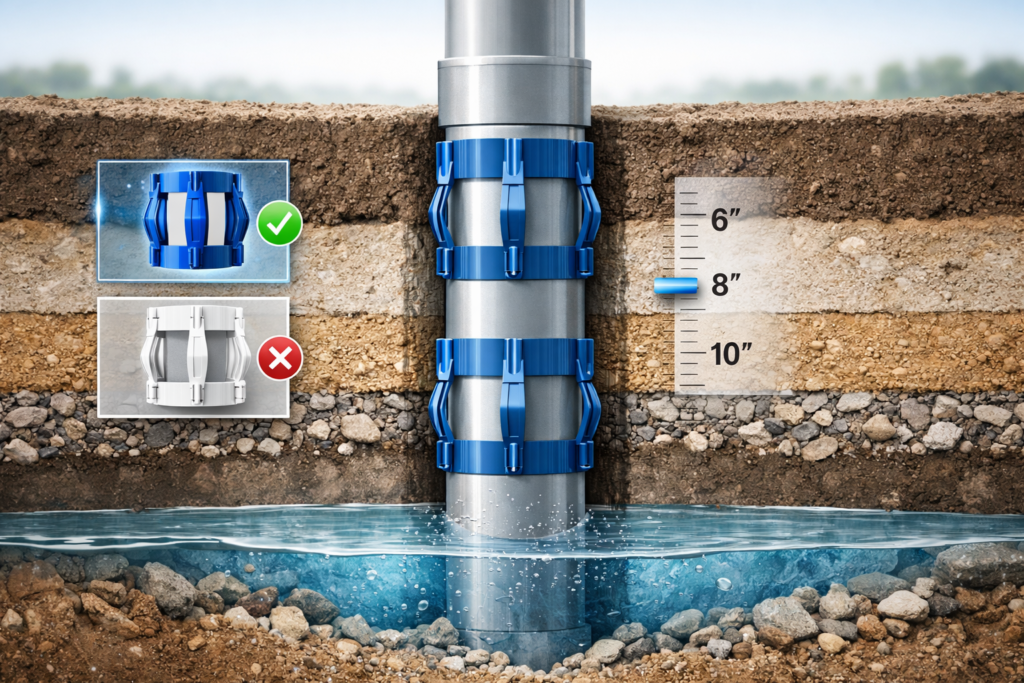
A poorly centralised borewell casing leads to uneven gravel packing, reduced pump efficiency, and premature casing failure. Choosing the correct PVC casing centralizer is one of the most critical decisions in any borewell project, yet it is often overlooked. This guide walks you through everything you need to know before making your selection.
What Is a PVC Casing Centralizer?
A PVC casing centralizer, also known as a casing spacer, is a moulded plastic device that fits around the outside of a borewell casing pipe to keep it perfectly centred within the borehole. Without centralizers, the casing leans against the borehole wall, causing problems that range from gravel bridging to casing collapse under load.
In India, with groundwater depths increasing every year, the use of quality casing spacers has become essential for municipal, agricultural, and industrial borewells alike.
Why Centralizers Matter for Borewell Performance
When a casing is off-centre inside a borehole, the annular space becomes uneven. This creates a chain of problems that affect the long-term performance of the well.
Uneven annulus causes bridging and voids in the filter pack, which directly reduces aquifer yield. Off-centre casings also stress submersible pump columns, leading to vibration and premature wear on the pump motor. Poor centralisation creates gaps in the grout seal that allow contaminated surface water to enter the well. Over time, mechanical stress on a leaning casing accelerates fatigue cracking and shortens the useful life of the entire borewell.
Key Factors to Consider When Choosing a Centralizer
Borehole Diameter vs Casing Diameter
The most fundamental factor is the annular clearance, which is the gap between the outer diameter of the casing and the inner diameter of the borehole. Your borewell centralizer size must bridge this gap snugly, without applying so much radial force that installation becomes difficult.
A common mistake among drillers in India is selecting centralizers based on casing size alone, ignoring the actual borehole diameter. Borehole diameter can vary by plus or minus 20 mm from the nominal drill bit size due to formation instability. Always measure the actual borehole before ordering.
Depth of Installation
Deeper borewells, particularly those beyond 150 metres, subject the casing and centralizers to significantly higher hydrostatic pressure and axial loading during installation. For such depths, choose centralizers made from high-impact rigid PVC or fibre-reinforced variants rather than standard flexible designs.
Formation Type
In hard rock formations such as granite and quartzite, borehole walls are stable and the centralizer’s main job is alignment. In soft or unconsolidated formations such as alluvial plains and clay zones, the centralizer also needs to resist lateral loads from formation movement. Choose bow-spring style or multi-wing rigid PVC centralizers accordingly.
Spacing Interval
As a general rule for Indian borewell conditions, place one centralizer every 3 to 6 metres of casing. In deviated or deep wells, reduce this interval to every 2 to 3 metres. Centralizers should always be placed at the top, bottom, and at every pipe joint for maximum effectiveness.
In collapsible formation zones, doubling up centralizers at the top of the screened interval prevents the filter pack from migrating during development pumping. This practice is recommended by hydrogeologists across India.
Casing Material Compatibility
PVC centralizers grip best on PVC and uPVC casings. If you are using MS or GI steel casings in deeper industrial borewells, ensure the centralizer’s inner collar material is compatible and will not cause galvanic corrosion at the contact points.
Centralizer Size Reference Guide
Borehole 150 mm (6 inch), Casing OD 110 mm, Centralizer wing span approx. 150 mm: Suitable for domestic borewells.
Borehole 200 mm (8 inch), Casing OD 140 mm, Centralizer wing span approx. 200 mm: Suitable for agriculture and small municipal supply.
Borehole 250 mm (10 inch), Casing OD 160 mm, Centralizer wing span approx. 250 mm: Suitable for medium municipal supply.
Borehole 300 mm (12 inch), Casing OD 200 mm, Centralizer wing span approx. 300 mm: Suitable for industrial and deep borewells.
Borehole 350 mm (14 inch), Casing OD 250 mm, Centralizer wing span approx. 350 mm: Suitable for high-yield production wells.
How to Size a Centralizer Correctly: Step-by-Step
- Step 1: Confirm the actual drilled borehole diameter. Use a calliper log or consult the driller’s rig specification. Do not rely on the nominal drill bit size alone, as borehole enlargement is common in soft zones.
- Step 2: Measure the casing outer diameter. Standard PVC casings in India follow IS 12818 specifications. Confirm the exact outer diameter from your pipe supplier rather than relying on the nominal size label.
- Step 3: Calculate the annular clearance. Annular clearance equals the borehole diameter minus the casing outer diameter, divided by two. This tells you the required radial reach of your centralizer wings or bow springs.
- Step 4: Select the centralizer type based on formation. Use rigid multi-wing PVC for hard rock, bow-spring PVC for alluvial or soft formations, and roller centralizers for deviated holes.
- Step 5: Determine the spacing interval. Plan placement every 3 to 6 metres, and at every pipe joint. Mark positions on the casing string before lowering begins.
- Step 6: Check the installation torque rating. For deep wells, ensure the centralizer clamp can handle the combined weight of the casing string above it without slipping.
Types of PVC Casing Centralizers Available in India
Rigid wing centralizers have a fixed-blade design moulded from rigid PVC. They are best suited for vertical wells in hard rock and offer low cost with high reliability.
Bow-spring centralizers use flexible blades that apply continuous radial force. They are ideal for soft formations and maintain centring force even in enlarged boreholes.
Roller centralizers use rolling wheels to reduce drag during casing run-in. They are used in deep or deviated borewells where friction is a concern.
Split-body or clamp-on centralizers can be installed on assembled casing strings without threading. They are popular for retrofit projects and repair wells.
Common Mistakes to Avoid
Using a single centralizer size for all borehole diameters on the same project is one of the most frequent errors. Each borehole section may have different clearances and must be assessed individually.
Installing centralizers only at the bottom of the casing string leaves the upper sections uncentred, which compromises the grout seal and increases casing stress.
Choosing low-grade PVC that degrades in deep groundwater with high total dissolved solids leads to premature failure of centralizers in the well.
Ignoring formation type when selecting rigid versus flexible designs results in poor performance or difficulty during casing installation.
Over-tightening clamp-on centralizers on thin-wall PVC casings can cause cracking of the casing itself, creating a serious structural problem downhole.
Quality and Standards to Look for in India
When sourcing a casing spacer in India, look for products that conform to relevant IS standards for PVC material quality. IS 4985 applies to pressure pipes, and IS 12818 covers borewell casings. Reputable manufacturers will provide compressive strength data, temperature ratings, and chemical resistance certificates on request.
Avoid unbranded centralizers sold at local hardware stores. Dimensional tolerances in these products are often poor, resulting in a loose fit and migration of the centralizer during installation.
Conclusion
Selecting the right PVC casing centralizer is not a minor detail. It directly influences the structural integrity, yield, and longevity of every borewell project. The correct choice depends on borehole diameter, casing outer diameter, depth, formation type, and spacing interval working together.
Get expert help selecting the right size. Contact CPS Envirotech today.