
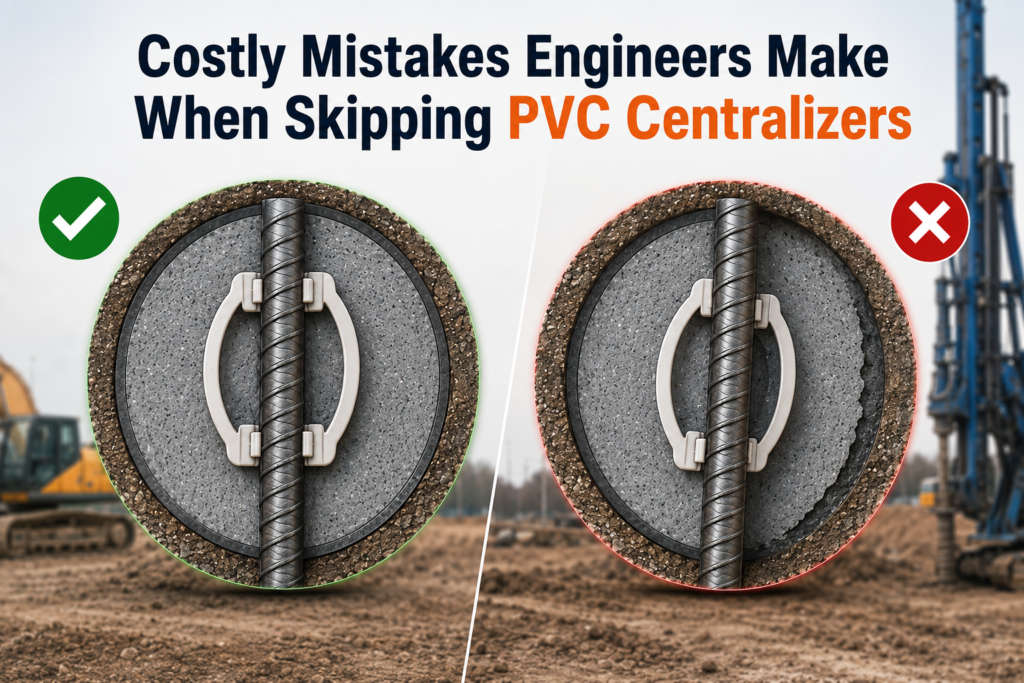
The decision to skip PVC centralizers rarely feels significant on paper. They are small. They are inexpensive. And no project owner ever pushes back on the structural calculation because centralizers are missing from it.
But the consequences of that decision show up years later, when grout cover fails, reinforcement corrodes ahead of schedule, or a pile rehabilitation project costs ten times what the original centralizer specification would have added to the budget.
This article identifies the five most costly mistakes engineers and contractors make when they skip or underspecify PVC centralizers, and gives you the exact steps to avoid each one. These mistakes are drawn from real failure patterns seen across micropile, soil nailing, casing, and diaphragm wall projects across India.
Key Takeaways
- PVC centralizers are structural components that protect the reinforcement bar throughout the entire pile service life
- The five most common mistakes happen at design, procurement, installation, site substitution, and value-engineering stages
- Each mistake produces the same outcome: inadequate grout cover, accelerated corrosion, and reduced pile load capacity
- Avoiding them requires correct specification, project-matched sizing, and no-substitution enforcement on site
What Are PVC Centralizers and Why Do They Matter?
A PVC centralizer is a rigid polyvinyl chloride spacer device that clips or ties onto a steel reinforcement bar at regular intervals before it is lowered into a borehole. Its function is to keep the bar perfectly centered inside the hole, maintaining a uniform annular gap between the steel and the borehole wall so that grout can flow and set evenly around the full circumference.
Without a centralizer, the reinforcement bar migrates toward the closest point of resistance during installation — the borehole wall. This leaves the steel touching, or nearly touching, the wall on one side and surrounded by excess grout on the other. The result is a structurally compromised pile before the project is even complete.
CPS Envirotech India manufactures a complete range of centralizer types for different foundation applications, including rigid PVC centralizers for micropiles, PVC casing centralizers for cased boreholes, soil nailing centralizers for slope stabilization, and D-wall centralizers for diaphragm wall applications.
The 5 Costly Mistakes Engineers Make When Skipping PVC Centralizers
Mistake 1: Assuming the Reinforcement Bar Will Stay Centered on Its Own
This is the foundational error behind most centralizer failures. Engineers who have supervised careful, methodical bar insertion sometimes assume that a slow, controlled installation will keep the bar centered. Physics disagrees.
A reinforcement bar has weight distributed along its entire length. As it enters the borehole, even small lateral forces from drilling fluid viscosity, residual cuttings, or minor borehole deviation will push it toward the wall. By the time grout injection begins, the bar may have shifted 15mm to 25mm from center, leaving one face of the steel with near-zero cover.
In micropile applications where borehole diameters commonly run between 100mm and 250mm, a 20mm offset on a 32mm bar leaves just 4mm of grout cover on one face. IS 2911 requires a minimum of 40mm. The pile is non-compliant before the grout has cured.
How to avoid it: Specify rigid PVC centralizers at the design stage with a placement interval of 2 to 3 metres for standard ground and 1.5 metres in soft or waterlogged conditions. Make centralizer placement a hold point in the inspection and test plan, not a verbal instruction on site.
Mistake 2: Treating Centralizer Cost as a Project Expense Rather Than a Risk Transfer
The unit cost of a PVC centralizer is low. For a standard micropile project across India, centralizer costs typically represent a fraction of one percent of total pile cost. Despite this, centralizers are regularly cut during value engineering reviews because they appear as line items with no structural calculation attached to them.
What that calculation misses is the cost on the other side of the ledger. Inadequate grout cover accelerates reinforcement corrosion, particularly in India’s coastal zones, industrial corridors, and areas with sulfate-rich soils. A pile with less than minimum grout cover may begin structural degradation within 10 years in aggressive ground conditions, against a design life of 50 years.
Rehabilitation of a failed micropile in an existing structure, particularly in underpinning or heritage building support applications, routinely costs 200 to 500 times the original centralizer specification. The centralizer budget does not get saved. It gets deferred with interest.
How to avoid it: Prepare a one-page lifecycle cost note that compares centralizer procurement cost against the probability-weighted cost of early pile rehabilitation. Present it during value engineering reviews. Include reference to IS 2911 minimum cover requirements and the consequences of non-compliance. For product options and specifications, visit the CPS Envirotech India product range.
Mistake 3: Specifying the Wrong Centralizer Type for the Application
Not all PVC centralizers serve the same purpose. Using a centralizer designed for cased boreholes in a micropile application, or a soil nailing centralizer in a diaphragm wall panel, does not just reduce efficiency. It can produce worse alignment than no centralizer at all, because the device introduces a fixed offset rather than maintaining a true center position.
The four primary centralizer types serve distinct structural contexts:
- Rigid PVC centralizers: for open-hole micropile and anchor applications where the reinforcement bar must maintain center position throughout grouting
- PVC casing centralizers: for temporary or permanent steel casing installations where the casing outer diameter must stay concentric in the borehole
- Soil nailing centralizers: for soil nail bars grouted into drilled holes in slopes and retaining walls, designed for shallower angles and nail bar diameters
- D-wall centralizers: for steel reinforcement cages in diaphragm wall panels, built for large panel widths and deep cage assemblies
How to avoid it: Match the centralizer type to the application at the design stage. If you are specifying for a project with multiple foundation types, specify each centralizer separately. CPS Envirotech India supplies all four types: rigid PVC centralizers, casing centralizers, soil nailing centralizers, and D-wall centralizers.
Mistake 4: Allowing Site Teams to Substitute Centralizer Sizes Without Approval
This mistake does not originate in the design office. It happens on site, during procurement, when the specified centralizer outer diameter is unavailable and a site engineer approves the nearest available size as an equivalent.
It is not equivalent. A PVC centralizer that is 10mm undersized in OD does not maintain the specified annular gap. It creates an offset that varies with borehole wall irregularities, often settling with the bar resting against the wall on the side opposite the centralizer contact point. The result is a consistent grout cover deficit on one face throughout the pile length.
Oversized centralizers cause a different problem. They generate friction during insertion, distort under load, and in driven applications can split or compress out of position, removing all centering benefit at the exact moment it is needed.
How to avoid it: Specify the centralizer outer diameter as a tied requirement in the bill of quantities, not a nominal or approximate dimension. State explicitly that no substitution is permitted without engineer review and written approval. Require the supplier to confirm the exact OD match to the borehole diameter and reinforcement bar size before delivery.
Mistake 5: Installing Centralizers at Standard Intervals Regardless of Ground Conditions
A centralizer specification that calls for 2.5 metre intervals is correct for competent ground. It is inadequate in soft clays, waterlogged formations, or chemically aggressive soils, and it will produce bar drift in exactly the zones where the structural consequences of poor grout cover are most severe.
In soft or saturated ground layers, the borehole wall provides less lateral resistance. Drilling fluid pressure and the weight of the reinforcement bar produce greater bar deflection between support points. A 2.5 metre centralizer interval in these conditions allows the bar to bow sufficiently to create contact with the borehole wall at the midpoint between centralizers.
This problem is particularly relevant in India’s coastal regions, delta soil formations, and areas with thick soft clay strata, where pile projects often penetrate multiple soil layers with significantly different competence profiles.
How to avoid it: Review the ground investigation report before finalising centralizer spacing. In layers identified as soft, loose, or chemically aggressive, reduce centralizer spacing to 1.5 metres. Note the adjusted spacing intervals against the soil profile in the method statement and make them enforceable on site through the inspection test plan.
How to Get Centralizer Specification Right: A Practical Checklist
Avoiding every mistake on this list requires action at three stages of the project.
At Design Stage
- Confirm borehole diameter, reinforcement bar diameter, and specify centralizer OD to match
- Select the correct centralizer type for the application: micropile, casing, soil nail, or D-wall
- Set spacing intervals based on soil profile, not standard practice: 2 to 3m in competent ground, 1.5m in soft or aggressive layers
- Reference IS 2911 minimum grout cover requirements in the specification and show how centralizer placement achieves them
At Procurement Stage
- Require material submittals from the supplier confirming PVC grade, exact OD, and load capacity before delivery
- State no-substitution requirement explicitly in the purchase order
- Source from a specialist supplier – CPS Envirotech India supplies project-specific PVC centralizers with full technical documentation at pvccentralizer.com
At Installation Stage
- Make centralizer placement a defined hold point in the inspection and test plan
- Verify spacing against the confirmed method statement before grout injection begins
- Photograph centralizer installation on the reinforcement bar before insertion as a quality record
Standards and Further Reference
For minimum grout cover requirements and pile foundation specification standards applicable in India, refer to IS 2911: Code of Practice for Design and Construction of Pile Foundations, published by the Bureau of Indian Standards. Visit www.bis.gov.in for the current version.
For international guidance on micropile design and construction, the FHWA Micropile Design and Construction Guidelines (NHI-05-039) provides detailed treatment of grout cover requirements and centralizer specification practice.
Conclusion
Every mistake on this list produces the same outcome: a pile that underperforms its design life, a client who bears costs that should never have existed, and a project record that reflects a specification failure that could have been prevented for less than one percent of pile cost.
PVC centralizers are not accessories. They are the mechanism by which minimum grout cover is achieved and maintained. Skipping them, substituting them, or underspecifying their spacing does not remove cost from the project. It defers cost to the remediation stage, where it arrives with a multiplier.
CPS Envirotech India manufactures rigid PVC centralizers, casing centralizers, soil nailing centralizers, and D-wall centralizers for the full range of Indian foundation applications. If you need help matching the right centralizer to your project, contact us for project-specific guidance.
Frequently Asked Questions
What does a PVC centralizer actually do in a micropile?
A PVC centralizer clips onto the reinforcement bar at set intervals and holds the bar in the center of the borehole during installation. This maintains a uniform annular gap between the steel and the borehole wall, ensuring grout flows evenly around the entire circumference of the bar when injected. Without it, the bar shifts off-center under its own weight and the pressure of drilling fluid, leaving one face of the steel with inadequate or zero grout cover.
Which PVC centralizer type do I need for a soil nailing project?
Soil nailing projects require a dedicated soil nailing centralizer. These are designed for the bar diameters, hole sizes, and installation angles typical of soil nail applications. Using a micropile or casing centralizer in a soil nail hole produces incorrect OD-to-hole matching and does not maintain the required grout cover for the nail bar.
How far apart should PVC centralizers be placed on a micropile?
The standard interval is 2 to 3 metres in stable, competent ground. In soft, waterlogged, or chemically aggressive layers, the interval should be reduced to 1.5 metres. The correct interval must be derived from the ground investigation report, not applied as a blanket figure across all pile lengths. IS 2911 provides minimum cover requirements that the spacing must reliably achieve.
Can I substitute a slightly different OD centralizer if my specified size is unavailable?
No. Centralizer OD must match the borehole diameter precisely. An undersized centralizer allows the bar to shift off-center, producing the same grout cover failure as using no centralizer at all. An oversized centralizer resists insertion, may distort or split under load, and can prevent the reinforcement cage from reaching the required installation depth. Contact your supplier for the correct size before installation proceeds.
Are PVC centralizers required under IS 2911?
IS 2911 specifies minimum grout cover requirements for pile reinforcement. PVC centralizers are the standard technical means of achieving and verifying that cover during installation. While IS 2911 does not specify a centralizer material, the minimum cover distances it requires cannot be reliably achieved without mechanical centralization devices in place throughout the reinforcement length.
Why are PVC centralizers removed during value engineering if they are structural components?
Centralizers are removed in value engineering reviews because they carry no structural calculation reference. Engineers sometimes fail to communicate that their function, maintaining minimum grout cover, is itself a structural requirement under IS 2911. The correct response is to document the IS 2911 cover requirement, show how centralizer spacing achieves it, and classify centralizers as a compliance item rather than an accessory.
Where can I source PVC centralizers for projects across India?
CPS Envirotech India Pvt. Ltd. supplies rigid PVC centralizers, casing centralizers, soil nailing centralizers, and D-wall centralizers for projects across India. Full product specifications and ordering are available at pvccentralizer.com. Project-specific sizing and volume supply enquiries are welcome.