
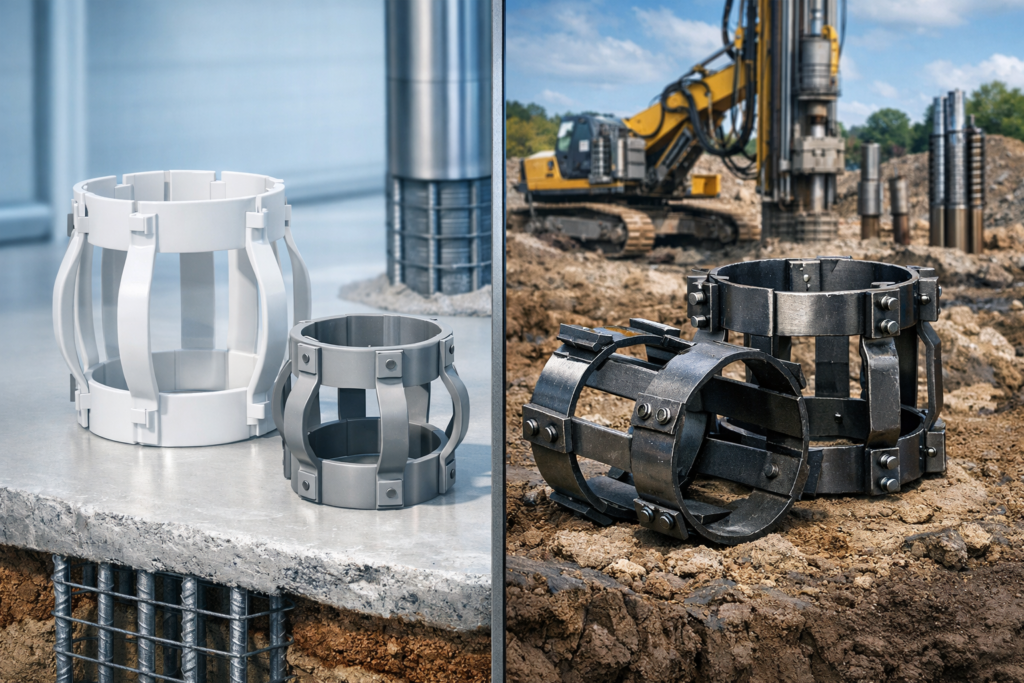
Choosing the right centralizer for your micropile project directly affects grout cover quality, reinforcement alignment, and overall structural performance. The debate between rigid PVC centralizers and steel centralizers is one that contractors and engineers across India face regularly. Both materials serve the same core function: keeping the steel reinforcement bar centered inside the borehole so grout distributes evenly around it. But the differences in cost, corrosion resistance, installation ease, and long-term performance are significant.
This comparison breaks down everything you need to know before specifying or sourcing micropile accessories in India.
What Is a Micropile Centralizer and Why Does It Matter?
A micropile centralizer is a spacer device attached to the reinforcement cage or bar inside a micropile borehole. It maintains a consistent annular gap between the steel and the borehole wall, ensuring adequate grout cover on all sides.
Without proper centralization, reinforcement bars shift toward one side of the borehole. This creates thin grout cover on one face and excess material on the other, weakening the pile’s load-carrying capacity and accelerating corrosion of the steel. In micropile applications, where pile diameters are small (typically 100mm to 300mm), even minor misalignment causes measurable structural compromise.
Getting centralization right is not optional. It is a foundational requirement in micropile installation, governed by standards such as IS 2911 in India and EN 14199 internationally.
Rigid PVC Centralizer: Key Characteristics
A rigid PVC centralizer is manufactured from high-density polyvinyl chloride, shaped into a circular or star-profile spacer that clips or ties onto the reinforcement bar at set intervals.
Corrosion immunity is the defining advantage. PVC does not rust, oxidize, or react with chlorides, sulfates, or acidic soil conditions. In coastal zones, marine environments, or chemically aggressive soils, this makes the rigid PVC centralizer a technically superior choice over bare steel options.
PVC centralizers are also significantly lighter than steel equivalents. Handling, transport, and site installation become faster, reducing labor hours. In projects with tight timelines or remote site access, this weight advantage translates directly into cost savings.
From a cost standpoint, rigid PVC centralizers are consistently more affordable per unit. For large-scale projects with hundreds or thousands of micropiles, the aggregate savings on centralizer procurement can be substantial. Procurement teams sourcing micropile accessories in India will find PVC centralizers widely available from domestic manufacturers, with shorter lead times than imported steel variants.
One limitation to note: PVC centralizers have lower compressive strength than steel. In extremely hard rock drilling or high-pressure grouting conditions, steel may offer better resistance to physical deformation during installation.
Steel Centralizer: Key Characteristics
Steel centralizers are fabricated from mild steel or stainless steel, typically welded directly onto the reinforcement cage or designed as bolt-on ring spacers.
Their primary strength is mechanical robustness. Steel centralizers withstand higher axial and lateral loads during installation without deforming. In hard formation drilling, dense cobble zones, or applications where the reinforcement cage is driven rather than lowered, steel holds its geometry under stress where PVC might compress or crack.
Stainless steel centralizers eliminate corrosion concerns but come at a significant premium. Mild steel centralizers, which are more commonly used, require protective coatings or rely on the grout cover to prevent corrosion. If grout placement fails partially and mild steel centralizer surfaces are exposed in aggressive soil conditions, long-term degradation becomes a concern, which is somewhat ironic given that the centralizer’s job is to protect the main reinforcement.
Steel centralizers are also heavier, adding to cage assembly weight and complicating installation in deep micropile applications. Fabrication costs are higher, and customization for non-standard pile diameters requires additional machining or welding work.
Side-by-Side Comparison: Rigid PVC vs Steel Centralizers
| Feature | Rigid PVC Centralizer | Steel Centralizer |
|---|---|---|
| Corrosion Resistance | Excellent (fully immune) | Moderate to high (depends on steel grade) |
| Unit Cost | Lower | Higher |
| Weight | Light | Heavy |
| Mechanical Strength | Moderate | High |
| Chemical Resistance | Excellent | Moderate (coating-dependent) |
| Installation Speed | Faster | Slower |
| Availability in India | Widely available | Widely available |
| Customizability | Moderate | High |
| Best For | Aggressive soils, standard conditions | Hard rock, high-load installation |
How to Choose the Right Centralizer for Your Project
The right choice depends on three project-specific factors: soil chemistry, installation method, and budget constraints.
Choose a rigid PVC centralizer when:
- The project site has corrosive, saline, or chemically aggressive soil conditions
- Standard drilling conditions apply (rotary or percussion in soft to medium formations)
- Cost efficiency is a procurement priority
- The project involves a high volume of micropiles where per-unit savings accumulate
Choose a steel centralizer when:
- The drilling formation is extremely hard rock where PVC may deform under physical impact
- The reinforcement cage must withstand significant pushing or driving forces during installation
- Stainless steel is specified for ultra-long service life in critical infrastructure
For the majority of micropile projects across India, including underpinning, slope stabilization, and building foundation retrofits, rigid PVC centralizers meet all technical requirements at a lower total cost.
Procurement Tips for Micropile Accessories in India
Sourcing the right micropile accessories in India requires working with suppliers who understand the specific demands of micropile construction, not just general civil engineering supply.
When evaluating suppliers, confirm that centralizers are available in the exact outer diameter matching your borehole and cage dimensions. Standard centralizer sizes typically range from 100mm to 300mm OD, but project-specific tolerances matter. Request material test certificates for PVC grade and thickness, especially if your specification requires compliance with IS or EN standards.
Ask whether the supplier offers complete micropile accessory packages, including tremie pipes, shear connectors, and coupling sleeves, since sourcing from a single supplier reduces coordination overhead and often provides better pricing.
For authoritative guidance on micropile design and specification standards, refer to the Bureau of Indian Standards at www.bis.gov.in, which publishes IS 2911 covering pile foundation requirements applicable to micropile systems in India.
Conclusion
Both rigid PVC centralizers and steel centralizers serve a critical function in micropile construction, but they are not interchangeable in every situation. PVC centralizers deliver superior corrosion resistance, lighter weight, faster installation, and lower cost, making them the practical first choice for most projects. Steel centralizers hold their place in demanding, high-load, or hard-rock installations where mechanical strength outweighs cost considerations.
For the majority of Indian micropile projects, a rigid PVC centralizer offers the best combination of technical performance and cost efficiency. Understanding your site conditions and specifying the right centralizer from the outset prevents structural compromise and avoids costly rework down the line.
Contact us today to discuss your micropile accessory requirements and get expert recommendations tailored to your project specifications.