In underground construction and foundation engineering, strength does not depend only on concrete grade or steel quality, and positioning accuracy plays an equally important role. Many structural failures are not caused by weak materials, but by reinforcement bars or pipes being installed incorrectly inside drilled holes.
A reinforcement bar touching the side of a borehole, a casing pipe leaning slightly, or uneven grout thickness may look minor during installation. However, these small misalignments can reduce load capacity, accelerate corrosion, and shorten the life of the structure.
To prevent this, engineers use a small but essential component: the PVC centralizer, a core product manufactured by CPS Envirotech India Pvt. Ltd. for geotechnical and foundation applications.
What Is a PVC Centralizer?
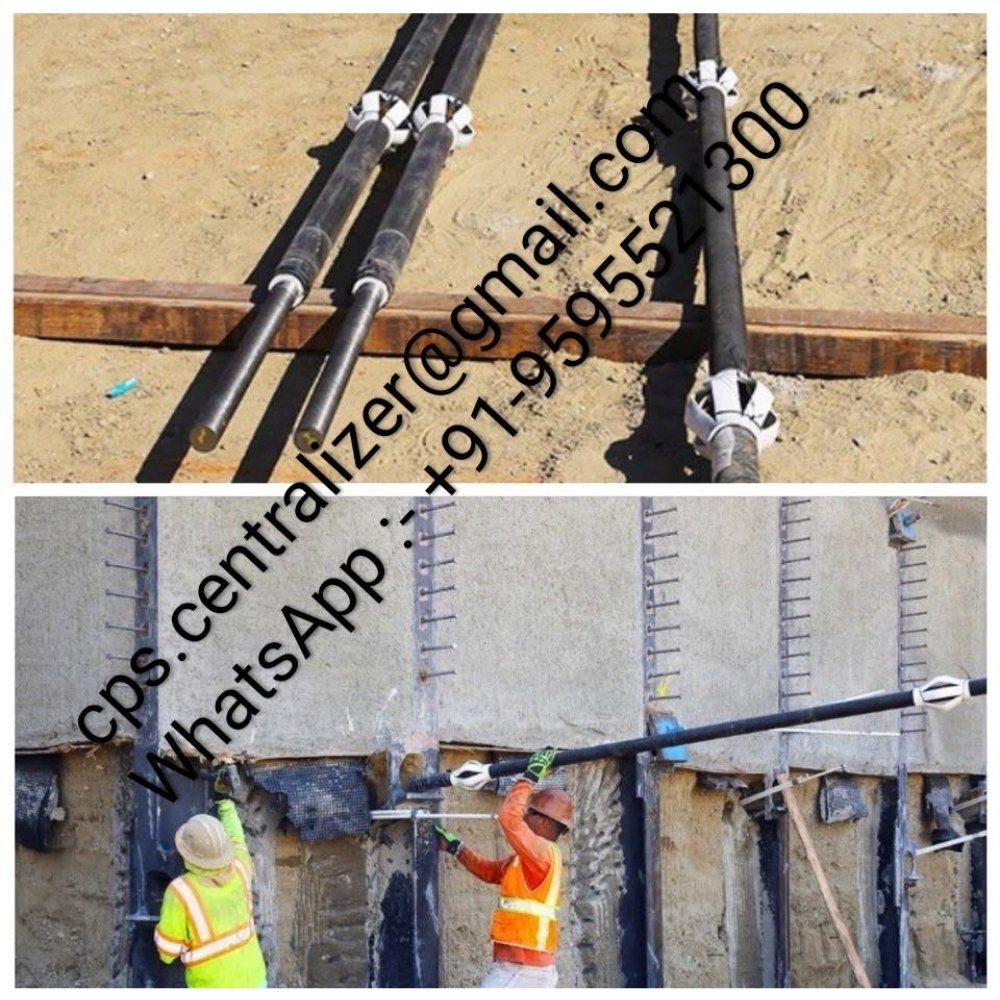
A PVC centralizer is a specially designed plastic device fixed around a steel bar, anchor, or pipe to keep it perfectly centered inside a drilled hole, casing, or concrete shaft.
Its main purpose is to maintain equal spacing called cover thickness between the reinforcement and surrounding grout or concrete.
This spacing ensures that protective material surrounds the steel uniformly from all sides. The centralizer acts as a guide and support during insertion, preventing the bar from bending, touching the wall, or shifting during grouting.
Without it, the reinforcement naturally rests against one side due to gravity and drilling irregularities.
Why Proper Centralization Is Important
Underground construction elements are hidden after installation. Once concrete or grout sets, corrections are impossible. That’s why correct alignment during installation is critical.
1. Uniform Load Distribution
Structural elements like soil nails, anchors, and micropiles transfer load into the ground through bonding between grout and steel.
If the bar touches one side:
- Load concentrates at limited contact points
- Bond strength reduces
- Pull-out capacity decreases
A centralizer ensures the load transfers evenly along the entire length of the element.
2. Corrosion Protection
Concrete or grout acts as a protective barrier against moisture and chemicals in soil.
If steel touches soil or casing:
- Water directly reaches the steel
- Rust forms early
- Cross-section reduces
- Structural strength declines over time
Maintaining proper cover thickness dramatically increases the lifespan of underground reinforcement.
3. Better Grouting Quality
Grout must fully surround the reinforcement to achieve proper bonding.
When the bar is off-center, grout cannot flow uniformly.
This creates:
- Air voids
- Honeycombing
- Weak bonding zones
Centralizers create a continuous flow path around the bar, ensuring complete encapsulation.
4. Structural Reliability
Design engineers calculate load capacity assuming uniform cover and bonding.
Improper positioning means actual site conditions differ from design assumptions, making calculations unreliable.
Centralizers ensure site execution matches engineering design.
Applications of PVC Centralizers
They are used in almost all geotechnical reinforcement works where alignment inside a hole matters.
Soil Nailing: Used in slope stabilization and excavation support. Soil nailing centralizers maintain equal grout thickness around the nail to achieve design pull-out resistance, ensuring reliable performance in challenging ground conditions.
Micropiles: Deep foundation elements transferring structural load to deeper strata. Rigid PVC centralizers ensure correct alignment and full bonding along pile length, maximizing load transfer capacity in micropile applications.
Borewell & Casing Installation: Heavy-duty PVC casing centralizers keep casing pipes perfectly centered, preventing deviation and collapse during drilling operations. Their robust construction withstands the demanding conditions of water well and borewell installations.
Ground Anchors: Improves load transfer between anchor bar and surrounding grout body, ensuring optimal pull-out resistance in permanent and temporary anchoring systems.
Diaphragm Walls: D-Wall centralizers maintain precise reinforcement cage positioning inside slurry trenches before concreting, ensuring consistent concrete cover and structural integrity in deep foundation and basement construction.
Products from CPS Envirotech India Pvt. Ltd. are commonly used in these applications due to their durability and precise fit.
Why PVC Is Preferred Over Metal
Earlier projects often used steel spacers or improvised supports. Modern construction prefers PVC centralizers due to performance advantages.
- Corrosion Resistant: PVC does not rust or react with groundwater or soil chemicals.
- Lightweight: Easy to transport and install, reducing labor effort and installation time.
- Non-Reactive: Does not affect grout chemistry or concrete bonding.
- Cost Effective: Lower manufacturing and maintenance cost compared to coated metal spacers.
- Pipe Friendly: Does not damage casing pipes during insertion.
Common Problems When Centralizers Are Not Used
Many site failures originate from improper positioning rather than poor material quality.
Typical issues include:
- Inclined or bent reinforcement bars
- Uneven grout cover
- Reduced pull-out strength
- Early corrosion
- Water seepage paths
- Cracks in retaining structures
- Foundation settlement
- Reduced design life
Most of these problems appear months or years later, making them expensive to repair.
How Centralizers Improve Construction Quality
A simple positioning device can significantly improve performance:
| Construction Factor | Without Centralizer | With Centralizer |
| Bar alignment | Random | Perfectly centered |
| Grout thickness | Uneven | Uniform |
| Bond strength | Reduced | Maximum |
| Corrosion risk | High | Minimal |
| Structural life | Shorter | Longer |
| Inspection reliability | Uncertain | Predictable |
This is why modern specifications often require centralizers at fixed intervals along reinforcement.
Installation Concept
Centralizers are placed at regular spacing along the bar before insertion into the hole.
They guide the bar while lowering and keep it stable during grouting.
Spacing typically depends on:
- Hole diameter
- Bar diameter
- Element length
- Ground conditions
Correct spacing ensures the bar never touches the borehole wall at any point.
In construction projects, attention is often given to concrete strength, steel grade, and machinery. However, positioning accessories receive less attention even though they directly influence structural performance.
A centralizer costs very little compared to the overall project cost, but its absence can reduce load capacity and durability significantly.
This makes it one of the highest impact-to-cost components in geotechnical construction.
Conclusion
A PVC centralizer is a simple positioning device used to keep reinforcement bars or casing pipes perfectly centered inside boreholes or concrete elements. Despite its small size, it plays a critical role in ensuring uniform grout cover, proper load transfer, corrosion protection, and long-term structural durability.
Underground construction cannot be visually inspected after completion. Because of this, installation accuracy becomes more important than repair capability. Centralizers help guarantee that what engineers design is exactly what gets built on site.
For reliable positioning solutions, manufacturers like CPS Envirotech India Pvt. Ltd. provide engineered centralizers that support structural safety and extend service life in modern geotechnical projects.